The Metaverse Is Closer Than You Think! Here’s What to Expect
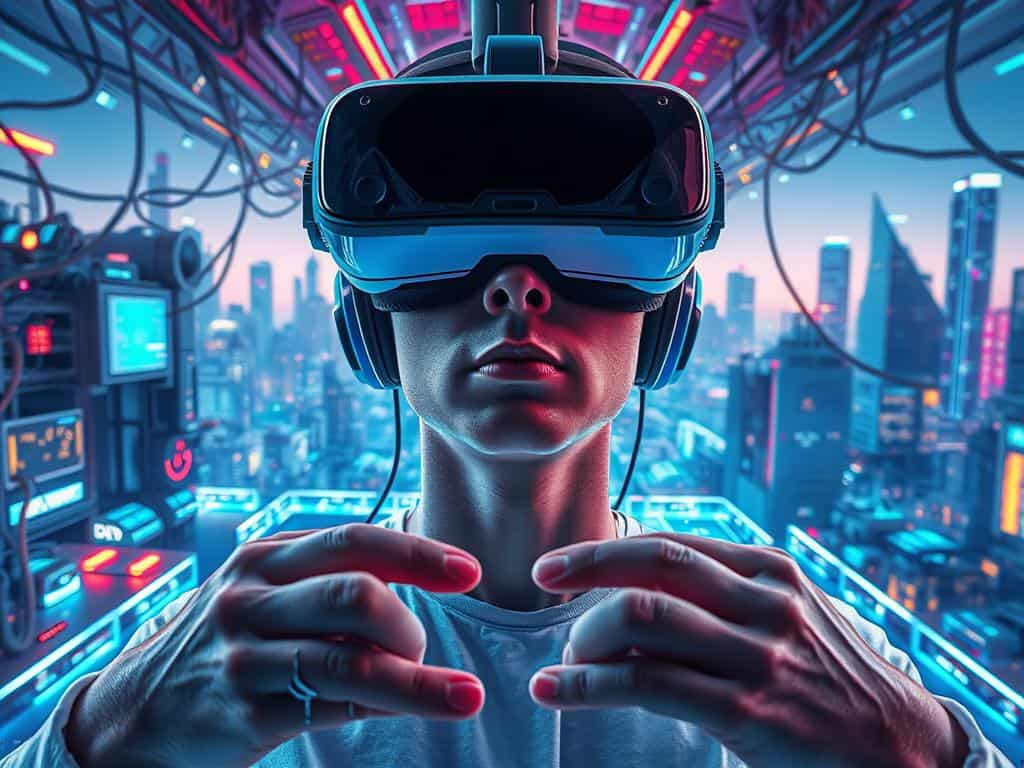
As I put on my VR headset for gaming, I thought about how digital worlds are now part of our lives. I went from battling in a game to enjoying a virtual concert. It was amazing to see famous artists perform in such detail.
These moments show us what the Metaverse could be like. It blends our real world with virtual reality. Companies like Meta Platforms Inc. are spending over $10 billion to make this happen. It feels like we’re on the edge of something big.
Imagine being able to meet friends in their digital worlds. This isn’t just science fiction; it’s happening. The VR market is set to grow beyond $300 billion by 2024. Cities like Seoul are creating virtual versions of themselves.
This shows us how close we are to the Metaverse. The experiences I had in games like those on the Oculus store are just the beginning. They hint at the social and economic possibilities that await us.
The Metaverse will change how we shop and entertain ourselves. As technology gets better, our experiences will become more meaningful. Let’s explore what the Metaverse is and what it means for us.
Key Takeaways
- The VR market, valued at $30 billion in 2021, is projected to exceed $300 billion by 2024.
- Meta Platforms Inc. is heavily investing in the Metaverse, contributing over $10 billion.
- Seoul plans to create a virtual replica of the city by 2030, marking a new era in urban planning.
- Virtual reality experiences are becoming increasingly popular, with games on platforms like Oculus generating over $1 billion in revenue.
- The Metaverse is set to transform social interaction and commerce, akin to the evolution of the internet.
- New technologies are emerging, promising to create previously unimagined economic opportunities.
- The average user base of Decentraland is growing rapidly, highlighting a keen public interest in immersive digital environments.
Understanding the Metaverse and Its Components
Exploring the Metaverse gives us a peek into a digital future. Here, immersive technologies like AR and VR change how we interact. The Metaverse is a vast digital world where users connect through avatars.
These virtual spaces allow for deeper social connections. They go beyond the usual online profiles.
What Is the Metaverse?
The Metaverse blends digital and physical realities. It lets users interact in new ways. It’s a network where communities can thrive, just like in the real world.
With big investments, the Metaverse is becoming a reality. It’s seen as a future as important as smartphones. This sparks excitement and curiosity in many areas.
Key Technologies Driving the Metaverse
AR and VR are key to the Metaverse. Companies like Meta are investing heavily. This shows the Metaverse’s huge promise.
The market is growing fast. It’s expected to hit $507.8 billion by 2030. VR is being used for training, making learning faster and more confident.
Historical Context and Evolution
The Metaverse’s history starts with Neal Stephenson’s “Snow Crash” in 1992. It has grown with tech advancements and Web 3.0. The COVID pandemic has made digital spaces more appealing.
Now, there’s a push to create digital worlds where users can move easily. This is driven by user behavior, technology, and societal needs.
VR & Metaverse: What to Expect in the Future
The Metaverse is set to change how we use technology. It will bring new and exciting ways to interact. From better remote work to virtual stores, the future is full of possibilities.
Businesses are starting to use immersive experiences in new ways. This is changing how we shop, learn, and connect with each other.
Potential Use Cases of the Metaverse
The Metaverse has a lot of uses in different areas. For example, Walmart is using VR for training, which has improved scores. Nike’s Nikeland on Roblox has drawn millions, showing the power of immersive experiences.
Prisms VR is also making virtual lessons for schools. This shows how the Metaverse can make learning better. These examples show the Metaverse’s growing role in our digital world.
Economic Impact and Market Predictions
The Metaverse’s economic impact is huge. It could add about $5 trillion to the economy by 2030. Investments in VR and digital assets like NFTs are growing fast.
Experts think over 2.6 billion people will use Metaverse platforms by 2030. This big change will affect many businesses. They will need to adapt and find ways to benefit from the digital economy.
Conclusion
The Metaverse is changing fast and it’s not just a dream anymore. It’s going to change how we talk, learn, and work. For example, Strivr’s tech for Walmart has made employees 30% happier and they remember things better by up to 15%.
Many areas are diving into the Metaverse, like schools using VR to make biology more exciting. Ikea even has a VR app to help customers see furniture in their homes. But we need to talk about privacy, fairness, and how it affects society.
There’s a lot of excitement about the Metaverse, but we also face big challenges. We need to make sure everyone benefits from these new technologies. The Metaverse could make a lot of money, with gaming alone expected to hit $660 billion by 2032. We’re on the edge of a new era, one filled with immersive tech.
