The Deep Ocean Is More Mysterious Than Space—Here’s Why!
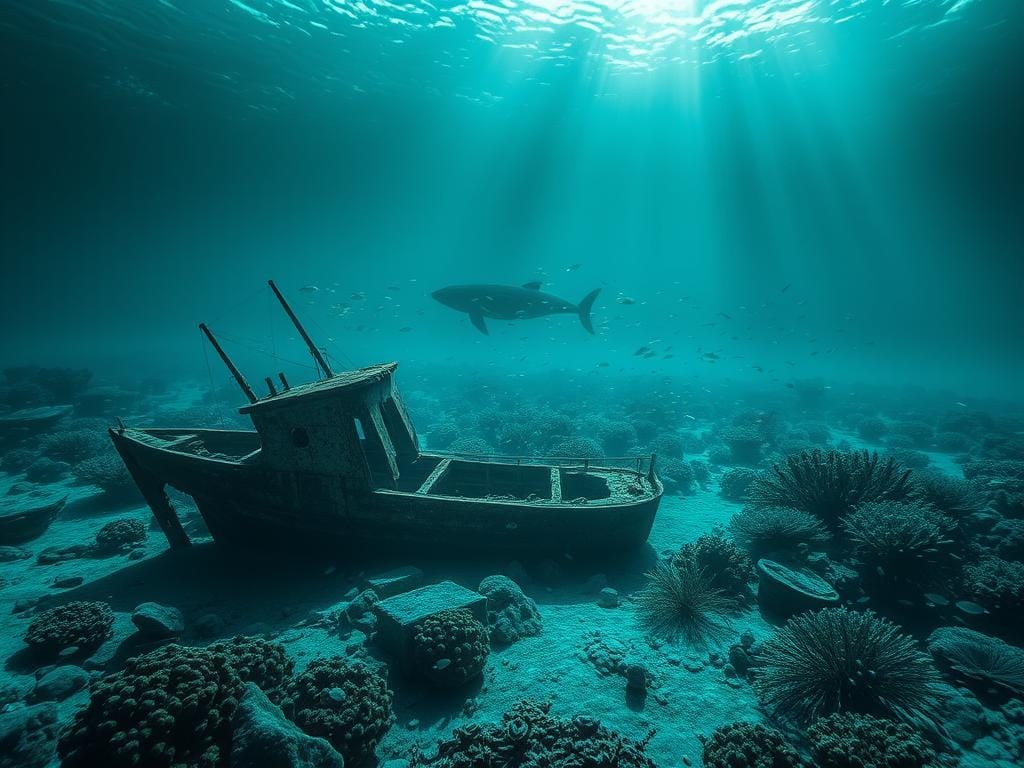
Standing at the edge of a cliff, I felt awe and wonder. The ocean stretched endlessly before me, shimmering in the sun’s rays. I thought about the secrets beneath the waves, more profound than space’s mysteries.
While we’ve been to the moon many times, few have explored the deep sea. Over 71% of Earth is water, and 95% of it is unexplored. The pressure is extreme, but life thrives in these depths.
This made me think of the ocean as our last great frontier. It’s waiting to reveal its secrets.
Key Takeaways
- The ocean covers over 71% of Earth’s surface.
- A staggering 95% of the ocean remains unexplored and unmapped.
- Only three individuals have descended to the Mariana Trench’s depths.
- Marine life has adapted to extreme conditions and high pressures.
- The ocean is home to around 230,000 known species, with estimates of over 2 million undiscovered.
- Over 90% of the ocean’s depths are yet to be observed, showing the vast unknown.
The Vastness of Our Oceans
The ocean covers about 71% of our planet’s surface. It holds vast, unexplored territories. Despite its size, many parts are not documented due to exploration challenges.
Understanding this vastness leads to discussions about its resources and the technology needed to explore it.
Understanding Ocean Coverage
Oceans make up 96.5% of Earth’s water, holding 320 million cubic miles. Less than 10% of the ocean has been mapped. This shows a big gap in our exploration.
High-resolution mapping technology has improved, with 26.1% of the seafloor mapped well. Yet, much of the ocean remains unexplored. The ocean’s resources, like minerals, are vital for U.S. security, making exploration urgent.
Exploring these waters, I realize how much we don’t know and how underappreciated they are.
Comparison with Space Exploration
Comparing ocean mapping to space exploration is striking. We know more about the moon than the ocean floor. The ocean’s average depth is 3,682 meters, a harsh environment with immense pressure and darkness.
Unlike space, which has received a lot of investment, deep-sea exploration is underfunded. As technology advances, I hope our efforts to map and explore the ocean will grow. This will help us unlock its secrets as we do with space.
Secrets of the Ocean
The ocean is a vast, unexplored frontier on Earth. It covers 70% of our planet but is incredibly hard to explore. The deep-sea’s extreme conditions, like crushing pressure and no light, make it a big challenge for researchers.
With 95% of the ocean unexplored, many secrets remain hidden. Even the latest technology can’t uncover all of them.
Exploration Challenges
Exploring the ocean’s depths is tough. The pressure at the bottom of the Mariana Trench is over eight tons per square inch. This is strong enough to crush most submersibles.
Mapping the ocean is also a challenge. Only features larger than three miles can be seen because of technology limits. It’s surprising that more people have gone to the moon than to the Challenger Deep.
Human Presence in the Deep
Only three people have reached the Mariana Trench’s depths. Each journey has uncovered new life forms, sparking curiosity. Recent trips have found hundreds of new species, like the “faceless fish.”
These discoveries make me wonder about life beyond Earth. They show us the diversity of life in the deep ocean.
Technological Advancements and Discoveries
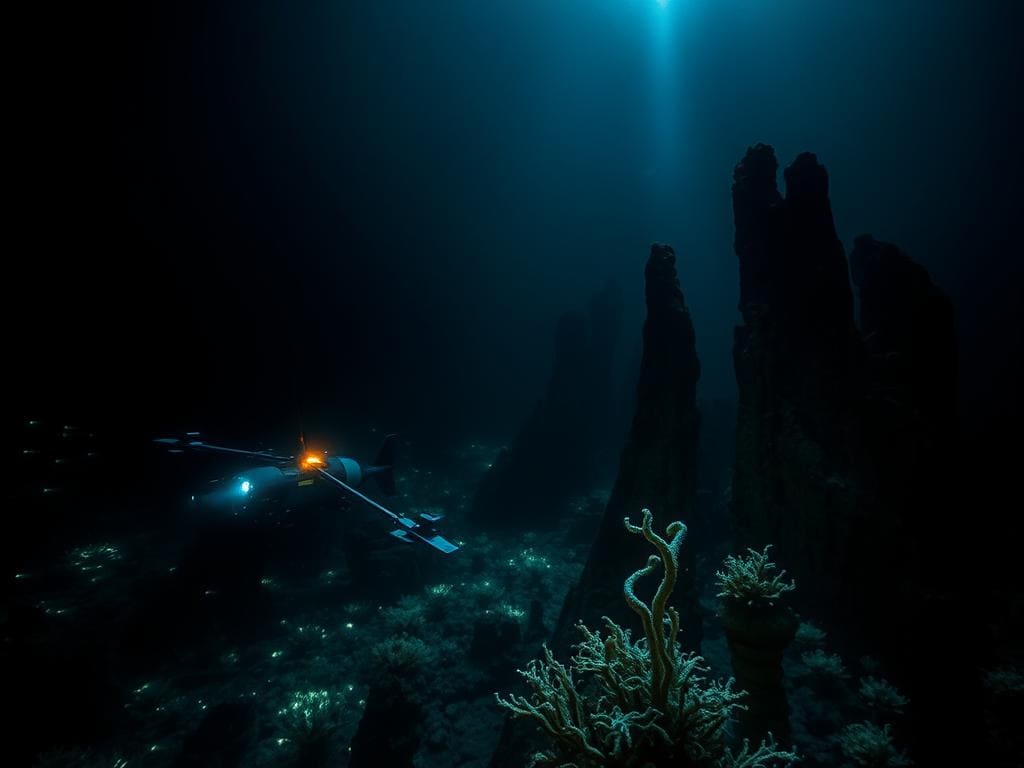
Recent tech breakthroughs are changing how we see the ocean’s depths. New tools like underwater robots and special cameras let scientists explore places they couldn’t before. These tools can handle the ocean’s harsh conditions and gather important data.
Emerging Technologies
Underwater tech has grown a lot in the last few years. Robots designed for underwater exploration can now stay out for longer periods. Øyvind Ødegård says these robots can change their path based on new data, unlike old robots.
Marine Life Discoveries
There have been many discoveries about marine life. Expeditions have found unique places around hydrothermal vents where life exists without sunlight. This research helps us understand life in extreme places.
As I learn more, I’m amazed by how marine life can survive and adapt.
Conclusion
Ocean exploration is key to understanding our planet and its future. The ocean, covering about 70% of Earth, holds secrets that can improve our lives. It offers resources and insights for medical breakthroughs and new energy sources.
Exploring the ocean’s depths is a big challenge. Yet, it’s as important as space missions. By using new technologies, we can learn how to manage natural hazards and fight climate change. Working together, like NOAA Ocean Exploration does, is vital for making progress.
There might be over a million species in the ocean that we don’t know about. Exploring the ocean can unlock its secrets and inspire the next generation. It could also help us understand life on Earth and maybe even beyond.
