Hyperloop, Flying Cars & More: The Future of Travel!
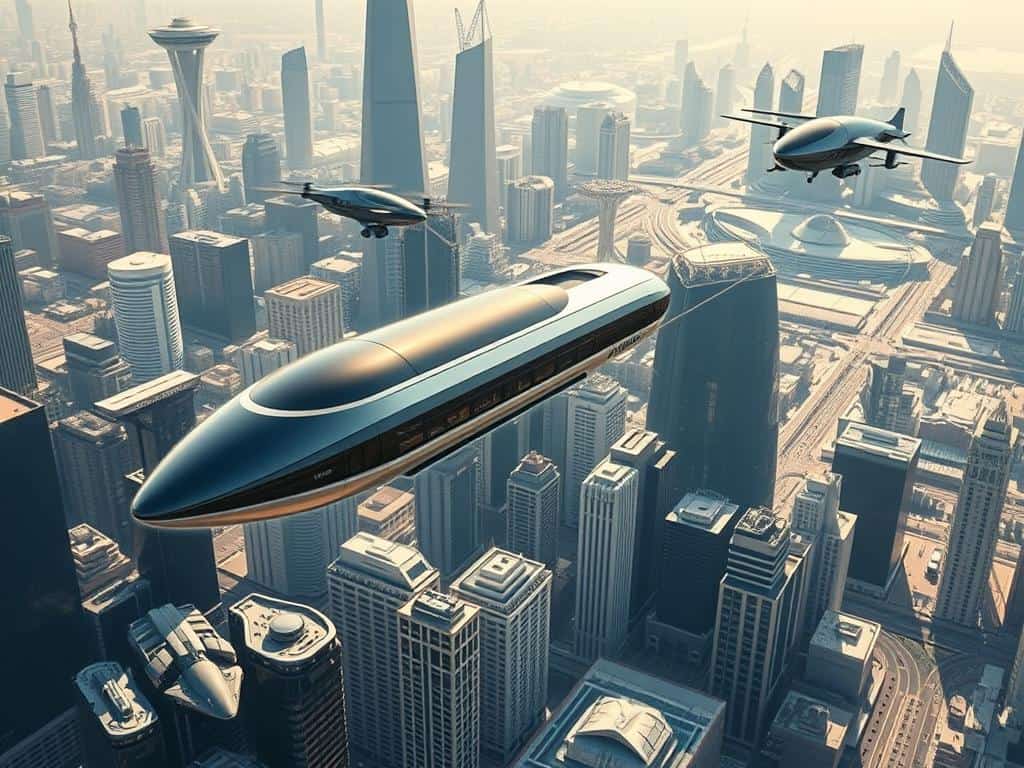
As I sat in my car, stuck in another traffic jam in Los Angeles, I thought about the future of travel. The frustration of watching the clock tick by was made worse by visions of an aerial highway above me. Flying cars zipped effortlessly from point A to point B in this world of innovation.
Elon Musk’s Hyperloop technology promises to make these dreams come true. It will allow us to travel at speeds over 700 mph, turning commutes into mere moments. With urban congestion getting worse and environmental concerns growing, we need new ways to move. We’re on the edge of a transportation revolution, ready to explore new ways to travel our cities and beyond.
Key Takeaways
- The future of transportation features innovative solutions to combat urban congestion and environmental issues.
- Hyperloop technology could revolutionize travel time between major cities, cutting it down by 75%.
- Flying cars are becoming a reality, with significant market growth predicted in the coming decades.
- Advancements in automation and electric vehicles will fundamentally change urban mobility.
- Next-gen transportation solutions promise enhanced safety, efficiency, and reduced emissions.
Introduction to Revolutionary Travel Concepts
Cities are growing fast, and traffic is getting worse. Our current transport systems can’t keep up with modern life. We need new, green ways to travel that are fast and good for the planet.
The Need for Innovation in Transportation
More people mean more cars, leading to long drives and pollution. In the U.S., cars and trucks cause 28.9% of greenhouse gas emissions. Electric cars and better public transport are key to fixing this.
Travel Challenges in Urban Settings
Driving in cities is tough due to too many cars and not enough space. Most cars sit idle most of the time. New ideas like car-sharing and self-driving cars could change this. They promise to make travel smoother and greener.
Hyperloop: A Leap in Speed and Efficiency
The Hyperloop is a game-changer in transportation, thanks to Elon Musk’s vision. It’s a high-speed travel system that moves passenger pods at over 700 miles per hour. This could make trips like Los Angeles to San Francisco just 30 minutes long.
This idea is thrilling because it could change how we travel. It promises to make our commutes faster and more efficient.
Elon Musk’s Vision and Implementation
Elon Musk came up with the Hyperloop idea in 2013. He wanted a new way to travel that would reduce traffic and improve efficiency. His idea has sparked many projects around the world.
In 2020, Virgin Hyperloop tested its pod, called “DevLoop,” and hit speeds over 240 miles per hour. They got $42 million in 2021 to keep improving. Other companies, like Hyperloop Transportation Technologies, also got funding to work on prototypes and plans.
Current Development Efforts and Future Prospects
Many companies are working hard to make the Hyperloop a reality. About 60% of people would use it if it’s safe and reliable. This could create thousands of jobs and boost the economy.
The Hyperloop could also make traveling faster and use less energy. This makes it a key player in the future of travel.
Environmental Impact and Energy Efficiency
The Hyperloop is good for the environment too. It uses solar panels to make energy, which is better than cars and planes. This means it could cut down on carbon emissions a lot.
Building and running Hyperloop systems might also use less energy. This makes it a step towards a greener future in travel.

Future Transportation: Flying Cars and Urban Air Mobility
Flying cars are now a real possibility, thanks to new technology and urban air mobility (UAM). These electric vehicles can take off and land vertically. They promise to change how we travel in cities.
The Transition from Science Fiction to Reality
Flying cars have been a dream for over a century. Now, thanks to tech, they’re closer to becoming a reality. Companies like Joby Aviation and Archer are leading the way with test flights and regulatory efforts.
In Europe, Volocopter showed flying cars can work in busy cities with a public test in Dubai.
Key Players in the Flying Car Market
Many companies are driving the flying car revolution. Joby Aviation and Archer are leading in the U.S. European innovators like Volocopter and Lilium are also making strides. China’s Ehang and XPeng are quickly joining the race, backed by government support.
The market is expected to grow to tens of billions of dollars by 2030. This will likely lead to intense competition and possible mergers in the UAM sector.
Benefits of Aerial Vehicles in Urban Environments
Flying cars could greatly improve city travel. They could cut travel times by avoiding traffic. This could also make it easier to reach remote areas for emergency services.
These vehicles might even be as affordable as taxis. This could make air travel more accessible to everyone.
Conclusion
Looking at the future of travel, we see big changes coming. The Hyperloop could reach speeds of almost 600 km/h. Flying cars are also on the horizon, changing how we move around.
These new ways to travel will make our daily commutes better. They will be faster and more efficient. This could make our lives easier and more sustainable.
Technology will soon connect cities and communities better than ever. We’ll see services that make travel up to 50% more efficient. But, we must also focus on green transportation.
We need to design travel solutions that are good for the planet. This means using less energy and reducing waste. It’s about making travel better for everyone and the environment.
In the end, the future of travel is about making it faster, better, and kinder to our planet. By embracing these changes, we’re creating a better world. It’s not just about tech; it’s about building a future that’s good for all of us.
