Crafting Your Perfect Tiny Home for Remote Work and Travel Adventures
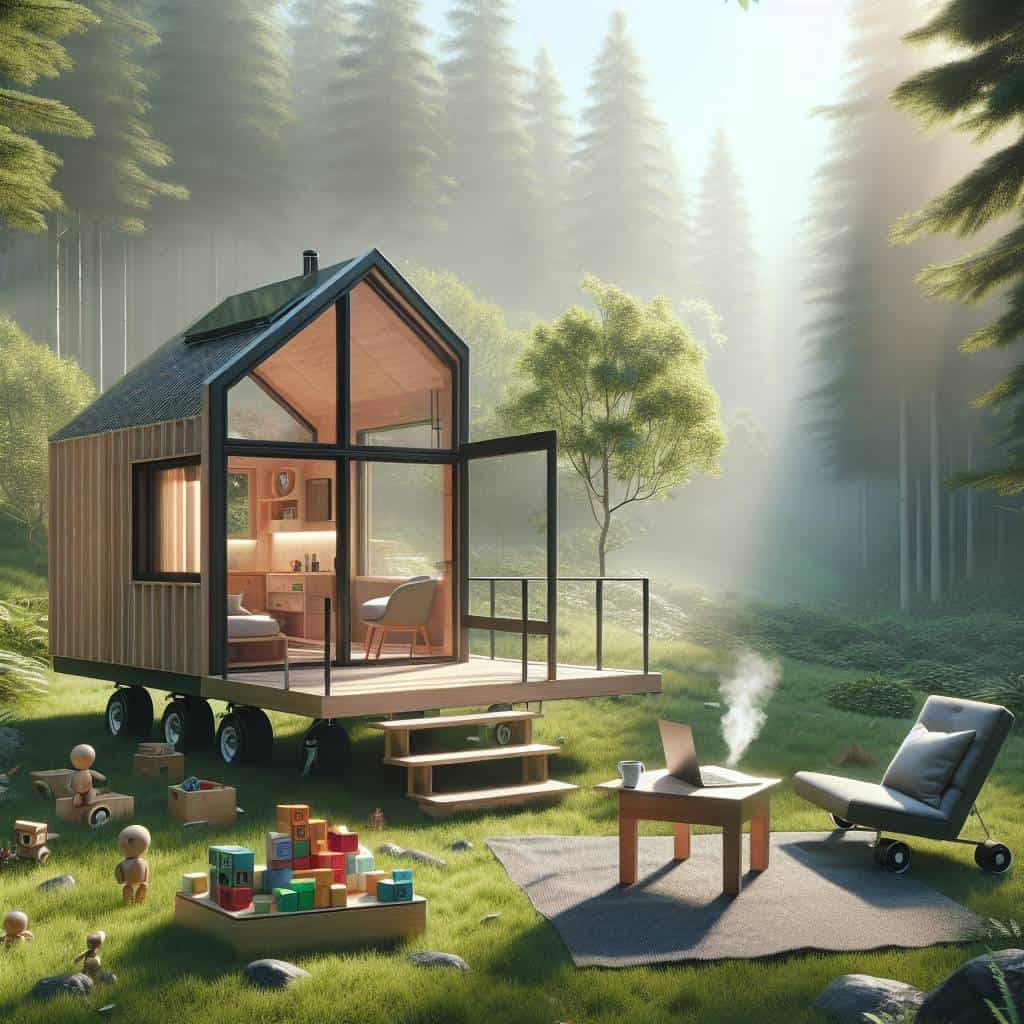
I once thought the idea of living in a tiny home was as appealing as a root canal. Who in their right mind would choose to live in a shoebox on wheels, trying to balance work and travel while dodging the kids’ Legos scattered across the floor? But then, a mountain of Zoom calls and the allure of unplugging from the chaos of city life played their hand. My tiny home journey began not with a grand plan, but a spontaneous decision after one too many days of staring at beige office walls. So here I am, figuring out how to make this sardine can of a house work for me, one misaligned nail at a time.
Now, if you’re thinking about diving into this compact adventure, hang tight. I promise we’ll cover the nitty-gritty without the sugar-coating. From the art of modular design to harnessing off-grid power, and yes, those mystical apps that promise to make your life on the road a breeze. We’ll also chat about convertible furniture—because nothing says “luxury” like turning your bed into a dining table. So grab a strong cup of coffee, and let’s wade through the blueprint of tiny home living without losing our minds.
Table of Contents
- From Concept to Chaos: My Modular Adventure in Tiny Home Design
- When Convertible Furniture Becomes Your Worst Enemy
- Off-Grid Power: Embracing the Dark Side of Solar Apps
- Why a Tiny Home is Your Ticket to Freedom (And Maybe Some Elbow Bruises)
- Tiny Home Living: The Brutal Truths You Need to Know
- Tiny Homes, Big Ideas
- Tiny Homes: Living Large in Small Spaces
- The Unexpected Joy of Living in a Jigsaw Puzzle
From Concept to Chaos: My Modular Adventure in Tiny Home Design
Picture this: I’m sitting at my kitchen table, which also happens to be my bed, my office, and on particularly ambitious days, my yoga studio. This is the modular magic of tiny home living—a concept that sounded like a minimalist’s dream but quickly turned into a circus of chaos. I started with a vision: a compact sanctuary for work and travel, powered by the sun and equipped with enough gadgets to make a tech nerd weep with joy. But here’s what they don’t tell you—bringing that vision to life is like assembling IKEA furniture with the wrong manual and half the screws missing.
The design phase was a wild ride. I wanted an off-grid haven with modular features that could morph like a Transformer. Ever tried to fit a full office setup into a space the size of a shoebox? Spoiler: it involves more Tetris-like creativity than you’d think. I was determined to include convertible furniture that could switch from desk to dining table faster than you can say “ergonomics.” Apps were my secret weapon, turning my phone into a command center for things like power management and climate control. But the reality of execution? Let’s just say my first attempt at a fold-out bed nearly left me with a squashed laptop and a bruised ego.
As I navigated this adventure, I learned that “modular” is just a fancy way of saying “you will rethink every design choice 27 times.” The chaos of living in a tiny, mobile space taught me to embrace imperfections. The power systems didn’t always align with my off-grid fantasies, and sometimes the furniture refused to convert without a stubborn nudge. But at the end of the day, this journey was about more than just building a tiny home. It was about crafting a life that fits into the palm of your hand—small, yes, but packed with potential. So, if you’re ready to wrestle with chaos and come out the other side with a portable slice of paradise, welcome to the club.
When Convertible Furniture Becomes Your Worst Enemy
Let’s talk about the seductive allure of convertible furniture. You know, those pieces that promise to transform your tiny home from a minimalist dream into a chaotic nightmare. It starts innocently enough—visions of a sofa morphing into a bed with a flick of the wrist, a table doubling as a storage unit. But reality hits when you wake up in the middle of the night, trapped in what can only be described as a furniture origami gone wrong. Suddenly, your living space is a minefield of hidden hinges and surprise compartments, just waiting to trip you up or swallow your last good pair of socks.
And then there’s the assembly. Oh, the sweet siren call of those flat-pack boxes, daring you to unleash your inner IKEA warrior. But what they don’t tell you on the label is that every transformation requires a Ph.D. in spatial reasoning and the patience of a saint. The manual? A cryptic scroll of hieroglyphics. The outcome? A Frankenstein’s monster of mismatched parts that may or may not support your weight. Yet, here we are, lured by the promise of adaptability, forgetting that sometimes, the best solution is a straightforward chair that just stays a chair.
Off-Grid Power: Embracing the Dark Side of Solar Apps
Ever tried harnessing the sun while living off-grid, only to discover that solar apps are like a bad date—promising the world but leaving you in the dark? Welcome to the shadowy realm of solar tech, where apps claim to be your trusty guide but often turn out to be as unreliable as a politician’s promise. You’d think that with all their flashy graphs and metrics, they’d have you covered. But oh, the reality check. These apps can be as temperamental as the weather they’re supposed to predict, leaving you frantically wondering why your batteries are emptier than your fridge after a weekend binge.
Let’s face it, relying on these digital companions is a bit like trusting a raccoon with your garbage. Sure, they look cute and helpful, but they’ll leave you with a mess. The trick is to embrace the chaos. Accept that sometimes, despite your best planning, you’ll find yourself sitting in candlelight, cursing at your phone. It’s all part of the off-grid charm, right? So, when your solar app fails you yet again, just remember—you’re not alone in this dark dance. You’re part of a gritty, resilient club that knows the real power isn’t in the app, but in your ability to roll with the unpredictability.
Why a Tiny Home is Your Ticket to Freedom (And Maybe Some Elbow Bruises)
- Start with a modular design, because who doesn’t love playing adult-sized LEGO with their living space?
- Go off-grid with solar power, unless you’re keen on spending your weekends searching for an outlet in the wilderness.
- Make it mobile: Nothing says ‘freedom’ like the ability to take your home wherever you please—just mind the speed bumps.
- Invest in convertible furniture; it’s high time your sofa pulled its weight as a bed, table, and maybe even a trapeze.
- Use apps to manage your tiny empire; if your phone can control the coffee maker, it’s basically magic.
Tiny Home Living: The Brutal Truths You Need to Know
Modular Design: Think of it as adult Tetris. Every inch must multitask. If your bed doesn’t double as a storage unit or transform into a dining table, you’re wasting precious real estate.
Off-Grid Power: Solar panels are your new best friend. But let’s be clear, a couple of cloudy days and you’re back to the Stone Age, so plan for backup power like a squirrel hoarding nuts for winter.
Convertible Furniture: Your couch is also your bed, your desk, and possibly your kitchen counter. If you’re not okay with that level of intimacy with your furniture, this lifestyle might not be for you.
Tiny Homes, Big Ideas
Why settle for a static box when you can have a modular sanctuary on wheels? Designing a tiny home isn’t just about saving space—it’s about crafting a life where your workspace and wanderlust coexist harmoniously.
Tiny Homes: Living Large in Small Spaces
How can I design a modular tiny home that doesn’t feel like a shoebox?
Ah, the age-old challenge of not going stir-crazy in 150 square feet. Modular design is your best friend here. Think Legos but for adults with a taste for minimalism. Opt for multi-functional furniture—like a couch that morphs into a bed or a table that moonlights as a work desk. And remember, every inch counts, so vertical storage is your new religion.
Can I go off-grid without living like a caveman?
Absolutely. Going off-grid doesn’t mean you have to trade your laptop for a parchment and quill. Solar panels are the go-to power source—just make sure you’ve got enough juice to keep your devices charged and your sanity intact. Composting toilets and rainwater collection systems can handle the rest, so you can enjoy nature without becoming one with it.
What mobile apps do I need for tiny home living?
Ah, the wonders of modern technology. Apps can help you manage everything from solar power levels to finding the nearest dump station. Try apps like Solar Analyzer for keeping tabs on your energy usage or Park4Night to find your next parking paradise. Who knew living small could require so much tech?
The Unexpected Joy of Living in a Jigsaw Puzzle
Standing here, in my tiny fortress of solitude, I can’t help but marvel at how a bunch of modular pieces came together to create a space that’s as mobile as my wanderlust. It’s a bit like living in a jigsaw puzzle where every piece has its place, but the beauty lies in the chaos—those moments when the off-grid power decides to take a little nap, or when my convertible furniture refuses to convert without a fight. Yet, this madness is precisely where the magic happens. It’s an exercise in patience and creativity, and somehow, it feels more like home than any four-bedroom house ever did.
So, you’re living the dream—or more like the “crammed into a tiny home but loving it” reality. You’re working remotely while exploring new places, and there’s nothing quite like the freedom of not being tied down. But let’s be real; even the most dedicated digital nomad needs a break from the four walls of their mobile closet. If you find yourself rolling through Spain and looking for some local flavor to spice up your itinerary, why not take a detour in Madrid? Not only is it a city rich in culture and tapas, but it’s also a great spot to meet new people. Need to chat with someone who knows the city inside and out? Check out putas baratas madrid for a lively conversation with locals who can point you to the best hidden gems in town. Because sometimes, the best part of traveling isn’t just the destination—it’s the people you meet along the way.
And let’s not forget the apps—my digital lifeline. They make off-grid living feel like a tech party, transforming this shoebox on wheels into a command center. Who knew I’d one day be optimizing solar power with my phone while sipping coffee with views that a penthouse suite would envy? This journey taught me that living small doesn’t mean living less. In fact, it’s about expanding your horizons while keeping your footprint light. So, if you ever find yourself considering this path, remember: it’s not just about the size of your home, it’s about the size of your adventure.
